Eastern subterranean termites
Termite control in Waterbury, CT
The termite found in Waterbury houses is the eastern subterranean termite, the species the Connecticut Agricultural Experiment Station says New England homeowners meet most often. If you have seen swarmers, mud tubes or hollow wood, call (475) 263-3625 to talk to an independent local pest control company about an inspection.
Termite or flying ant?
Most termite calls in Connecticut start with a handful of winged insects near a window or on the basement floor. Termite swarmers are dark brown to black, and many people take them for flying ants. Catch one in a jar or photograph it close up, then compare.
| Termite swarmer | Ant swarmer | |
|---|---|---|
| Antennae | Straight, like a string of beads | Bent at an elbow |
| Body | Thick from end to end, no narrow middle | A pinched waist between chest and abdomen |
| Wings | Two pairs of the same length, paddle-shaped | Front pair clearly longer than the back pair |
| When | Spring, mostly March to June; sometimes a warm day in January | Late spring into the fall |
Termite swarmers do not fly in summer or fall. A swarm in August is almost certainly ants, often carpenter ants. If you cannot tell, the Experiment Station's Insect Information Office in New Haven identifies insects for people in Connecticut, by email, mail or in person.
Signs inside the house
Swarmers are the first sign for many households, but the colony itself stays out of sight. Workers are pale, soft and blind, and they dry out in open air, so they travel inside the wood or inside tubes they build from soil.
- Mud tubes. Sandy tubes about the width of a pencil, running up a foundation wall, a pier, the side of a basement stair or a slab crack. Even an empty tube can mean termites were there.
- Wood that sounds hollow. Termites eat along the grain and leave a thin shell, so a joist or sill can look whole and still sound hollow when tapped.
- Galleries lined with soil. Break open damaged wood and the channels are plastered with a mix of soil and droppings. There is no sawdust pile; that points to carpenter ants instead.
- Shed wings in a heap on a sill, in a spider web or on the cellar floor after a swarm.
How they get from the soil to the wood
The colony lives in the ground. To reach a house it needs wood touching soil, or a covered path across concrete and stone. Older Waterbury foundations, porches built onto the house and firewood stacked against the siding all give it one.
The Experiment Station's advice for the ground around a house: keep firewood, lumber and brush off the foundation; set wood on stone or concrete at least six inches above the soil; use mulch sparingly and keep it off the siding; turn downspouts away from the wall; keep plantings about three feet out; do not run foam board insulation below grade; and separate wooden porches and decks from the house with metal flashing.
There is time to choose well
Termite damage moves slowly. The Experiment Station puts an average colony's appetite at about a square foot of wood a year, and says hasty action is not needed. That does not mean waiting; it means you can talk to more than one company before signing anything.
Talking to several companies has a second benefit: the same findings start to come up, and anything that does not match stands out. Ask each one to show you what it found.
Self-treatment is a poor fit for termites. Store products will not reach a colony in the soil, and the Experiment Station notes that homeowner treatments will not satisfy a home inspection if the house is sold later.
What an inspection and treatment usually involve
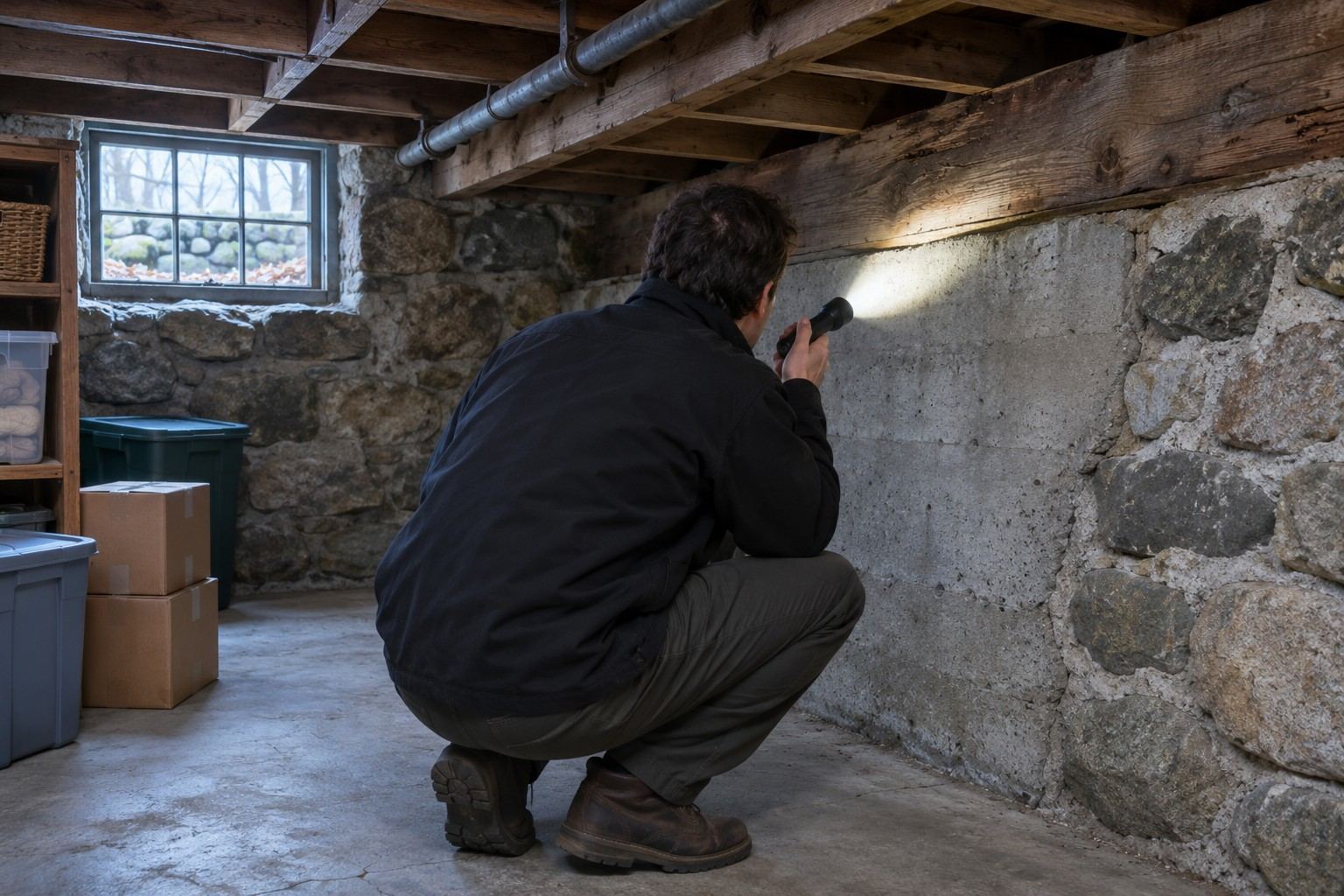
Expect the inspector to go around the whole foundation, inside and out: cellar walls, the sill line, crawlspaces, porches and steps, garage walls, and any wood in contact with soil. In a finished basement, they will ask what is behind the paneling.
The Experiment Station lists the usual approaches as termiticide injected into the soil, bait systems set in the ground, and barrier treatments around the foundation. Which one fits depends on the house, and the company decides. In Connecticut, that decision is made by a commercial supervisor certified by DEEP in category 7B, termites and other wood-destroying organisms (DEEP category list).
Before you agree to any treatment, Connecticut law requires the company to give you the key part of each pesticide label: product name, active ingredients, signal word, precautions and the re-entry statement. Read it with the company and ask how long people and pets should stay off treated areas.
Getting the house ready
Termite work happens at the edges of the house, so the job is mostly about clearing the way. Ask the company for its own list; this is what it usually asks for.
Before the visit
- Pull boxes, shelving and stored items a couple of feet away from the cellar walls.
- Open the way to crawlspaces, the bulkhead and the space under porch steps.
- Move firewood and anything leaning on the outside walls.
- Find out where the well, oil tank lines or buried cables run if the company asks.
- Plan where pets will be while work is done.
Termites when selling or buying a Connecticut house
A seller of a one-to-four family house in Connecticut fills in a residential condition report for the buyer (General Statutes section 20-327b). It asks directly about termite, insect, rodent or pest infestation problems, and separately about rot or water damage.
The law does not make the seller order an inspection, so buyers usually arrange their own. If a termite or wood-destroying insect inspection is part of your purchase, ask the company for its written findings, the name of the certified supervisor, and whether any past treatment shows.
Sellers who find termites before listing should keep the treatment paperwork. A record of what was done, by which registered business, answers the question the condition report asks.
Questions people ask
I found winged insects in the cellar in April. Is the house being eaten right now?
A spring swarm means a mature colony is close by and has found a way in, but the damage builds over years, not days. Keep a few of the insects, then arrange an inspection rather than tearing into walls.
Will termites come back after a treatment?
Ask each company whether its plan includes later inspections or monitoring, what those visits cover, and what happens if activity shows up again. Get the answers in writing.
Can I just spray the mud tubes?
Knocking down a tube does not touch the colony, and it removes the evidence an inspector would want to see. Leave it, take a photo, and call.
Still seeing it after dark?
Dial the number and describe what you found and where. An independent local pest control company that works around Waterbury talks it through and books a time to come out.